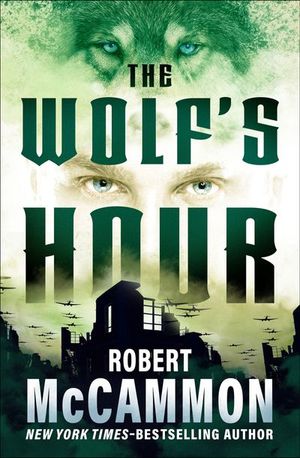
buy the ebookAmazonAppleB&NGoogleKoboOverDriveSonyshare The Wolf's Hour by Robert R. McCammon Book details Making of... On the eve of D-Day, a British secret agent with unique powers goes behind Nazi lines Michael Gallatin is a British spy with a peculiar talent: the ability to transform himself into a wolf. Although his work in North Africa helped the Allies win the continent in the early days of World War II, he quit the service when a German spy shot his lover in her bed. Now, three years later, the army asks him to end his retirement and parachute into occupied Paris. A mysterious German plan called the Iron Fist threatens the D-Day invasion, and the Nazi in charge is the spy who betrayed Michael’s lover. The werewolf goes to France for king and country, hoping for a chance at bloody vengeance. I began The Wolf's Hour with the idea that I wanted to do a different kind of werewolf story, coupled with elements of romance and heroism. I wanted my werewolf to be a man who often enjoys being a creature who runs on all fours, with a keen sense of smell and vision. Sometimes, Michael Gallatin would much rather be a wolf than a human being. I also wanted to do away with some of the conventions of the werewolf tale. I didn't see any need for werewolves to be restricted to the full moon in order to change, nor did it necessarily have to be night. I wanted to create creatures who had struggled to take control of their situation rather than being at the mercy of their circumstances. Which is not to say that a werewolf's life is easy; as one of the characters says, "A werewolf never dies of old age." As much as possible, I wanted to try to make the development and life of these creatures as believable as possible. Which meant they would learn to endure extreme hardship, because how else could they live but in a wilderness environment? But I think there would be great joy in learning how to see the world as a wolf does, in learning---and it wouldn't be easy---how to run on all fours and use your tail as a rudder, how to hunt prey and kill it with your teeth and claws, and generally survive on a level that is at the same time both brutal and elegant. The merging of brutality and elegance is what I was trying to accomplish, and I hope it succeeded reasonably well. The Wolf's Hour is set during World War II, and goes back and forth in time to show how Michael Gallatin became a werewolf and also follows his current mission in occupied France as a British secret agent. I've been asked why I chose World War II as my time frame, and not the modern era. My answer is that the period of the second World War appears to be---wrongly or rightly---a very romantic time in the history of the world. Romantic, that is, in the sense that one knew who wore the black hats and who wore the white hats. It was a period of apocalyptic decisions and events, and more surely the pivotal period of the twentieth century. It seemed right for The Wolf's Hour, which is basically the tale of nature versus technology. I also grew up reading the Ian Fleming James Bond novels, and I wanted to create a character who loved life yet had no qualms about killing if the situation demanded it. Michael Gallatin is not a man who kills for pleasure, but he is certainly a dangerous man because he knows---like the wolf does---that killing is basic to his survival. I also wanted Michael Gallatin to be a compassionate man, in that his work and the nature of killing is not his entire focus for being. He is a professional at his craft, but he's certainly not a machine and I wanted him to have very human emotions. The Wolf's Hour is a departure for me in that it's not necessarily a horror novel, though its basis is the werewolf tale. Not horror, at least, in the supernatural sense, but the horror in The Wolf's Hour is fashioned by human hands, with a "horror genre" figure as the hero. I wanted to turn around the popular culture idea of a werewolf being a dumb brute who in the light of the full moon is compelled to rend and destroy. In The Wolf's Hour, it's the world beyond the werewolves that is brutish and destructive, while the werewolves themselves kill not for pleasure, but for survival. I enjoyed researching wolf behavior before I started the book, and I also enjoyed reading a lot of military history and data about the personalities of the era, some of whom make appearances in the book. The Wolf's Hour was fun to write, and I hope in the future to continue Michael Gallatin's story. Copyright © 1989 by Robert R. McCammon. This essay originally appeared in Mystery Scene magazine, issue 20, March/April 1989. Reprinted with permission of the author.